Monday, January 11, 2010

Group Topic #3 - Manichaeism as a Syncretic Tradition

This week's readings on Manichaeism raise some interesting questions about the idea of syncretism and whether or not what Mani started could be considered a syncretic tradition or not.

On one hand, the term "syncretic" makes me think of an organic process in which two traditions merge out of either mutual (or similar) beliefs... or when two distinct cultures live harmoniously for a long period of time and eventually use some of the same terminology, whether or not they hold the same meaning for both groups.

Manichaeism, for me, doesn't completely fit into either of those categories, as Mani seems to have hand-crafted his religion in order to seem cohesive with the major religious traditions in his part of the world. By redefining terms such as "Buddha" and "Bodhisattva," as well as using his own concepts of Light and Dark to explain the origins of mankind ["Eve, whose body contained less Light than his, allowed herself to be seduced by a demon, whereupon she gave birth to Cain and Abel." (Klimkeit article)], he in a sense was able to provide a tradition which all people could instantly relate to, whether or not he was using their religious terminology "correctly." I have difficulty calling Manichaeism a "syncretic" tradition with the knowledge of its goal-oriented formulation; it seems to have been too calculated, focusing solely on targeting specific religious traditions and leadings their followers toward his religion instead.

But maybe I'm being naive in my idea of what a truly "syncretic" tradition should be!

Friday, January 8, 2010

Blog Post #6 - Nestorian Christianity in Tang China

[Bundy, David D., "Missiological Reflections on Nestorian Christianity in China during the Tang Dyanasty."]

Before doing the readings this week, I began to wonder why the Nestorian church ultimately faced a decline in Tang China. Its ability to adapt to the Chinese culture and the Chinese people's willingness to accept it as a foreign tradition seemed to create quite a bit of stability. In the Bundy reading, though, I was reminded of something we talked about in class this past Tuesday: the selling of ordinances. With the need for governmental income becoming desperate, the Chinese government's policy of eliminating all ordinances seems to have applied to all religious institutions at the time, especially monasteries:

"A decree dated September 12, 845 C.E. recounts the ordered dissolution of monasteries throughout the empire (not just the Christian ones) and the repatriation of foreign monks... The monks were required to return to lay life, resume their original occupations and pay taxes" (19).

This setback, along with "the competition of a vigorous Buddhism and its distance from the ecclesiastical centers in Mesopotamia" all seem to have played large roles in the disruption of the growth of the Nestorian church in Tang China (24).

I found especially interesting the openness of the Chinese people during the Tang dynasty (at least in the two capital cities) to foreign cultures. Capital cities tend to be the epicenters of multiculturalism, and Ch'ang-an and Lo-yang seem to have been no different. With the acceptance of Western music, food, clothes, and makeup, it's no surprise that the Nestorian Christians were relatively welcomed there, as opposed to more rural parts of China and the rest of Asia. These cities were likely the only places Nestorian Christian could have possibly taken hold so far east!


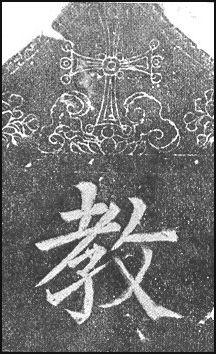
No wonder people's minds were blown when they saw the Chinese writing inscribed next to a cross -- it was so localized, it was virtually nonexistent in rural China.